



Strategies and Prompting in the Accounting Classroom: Harnessing AI for Effective Learning
This is an author interview with Mfon Akpan, author of Strategies and Prompting in the Accounting Classroom
- What inspired you to write this book, and what gaps were you seeing between the growing interest in AI and what accounting educators could actually use in their classrooms?
The technology is changing so fast, and I wanted educators to have a reference point – a baseline or foundation they could build on. I also wanted the book to be, in some sense, technology-agnostic. No matter how the technology develops, educators should be able to use it to move forward, generate ideas and train others to use the technology effectively.
- You distinguish between ‘learning with AI’ and ‘learning for AI-enabled practice’. What does that distinction mean, and why is it important for preparing the next generation of accountants?
‘Learning with AI’ means using the technology to help students understand key concepts. ‘Learning for AI-enabled practice’ means learning how to use the technology in real work situations – for example, how to build workflows that produce practical outcomes in the workplace. The distinction matters because these are two different use cases. As educators, we can use AI to help students learn, but we also need to prepare them to put it into practice. At the same time, we need to humanise our courses – teaching students how to use the technology while ensuring we can distinguish their own work from work produced by AI.
- Your book presents prompting as more than a technical skill. How does teaching students to structure a prompt around role, task, context, constraints and criteria help them develop stronger accounting judgment
This is important because, as we move further into agentic AI, much of the work will involve employees telling agents what to do and describing what needs to be done. In computer science, we call this a specification, or ‘spec’. The ability to explain the desired outcome, parameters and constraints is becoming a critical skill. I have heard the phrase that we are moving from ‘accountant’ to ‘accounting engineer’ – someone who designs agentic systems, tells those systems what to do and manages them. Accounting judgment remains essential because the accountant is still the driver: deciding how far the system should go, what it should do and whether the output is appropriate. Prompting is therefore evolving into something more like creation – building structured frameworks that guide agents as we move towards more agentic AI systems.
- Could you walk readers through one classroom activity from the book that demonstrates how students can use AI while still doing the thinking, checking and decision-making themselves?
If you look through the book, one of the through lines in the activities is ‘generate and review’. Students begin by using AI, which involves knowing which tool to use, understanding the context, structuring the prompt and generating an output. Then they review that output. The process starts with AI, but it ends with the human. Across the activities, students remain responsible for checking the output, applying judgment and making the final decisions.
- You emphasise a ‘generate, then review’ approach and require students to document their prompts, revisions and verification. How can instructors use this process to distinguish genuine learning from simply submitting an AI-generated answer?
The ‘generate, then review’ approach is straightforward and, in my view, technology-agnostic. No matter how much the technology changes – from generative AI to agentic AI to swarms of agents – there is still a human in the loop. A person initiates the task, sets the parameters, manages the process and reviews the output. In the classroom, instructors can evaluate not only the generated answer but also how students set the parameters, revise the work, check the results and explain whether the output makes sense. That record helps distinguish genuine learning from simply turning in AI-generated work. For example, Oath is a CPA firm that uses an AI-native approach to auditing. An AI system may perform much of the audit work within defined parameters, but a human must still assess whether the necessary steps were completed, determine whether the results make sense and ultimately sign off on the report. Over time, the review may become less hands-on and more like checking that the system has met the required criteria, but human responsibility remains. I cannot predict how deeply humans will be involved in the long run or how trust in AI systems will evolve. In the near term, however, ‘generate, then review’ is a strong practice for both the classroom and the workplace.
- For an accounting instructor who is interested in AI but feels overwhelmed, what is one practical change they can make in their next class without redesigning the entire course?
Start by incorporating AI into one existing assignment rather than trying to redesign the entire course. The pace of change can feel overwhelming – I feel it too – but these systems are becoming more capable and more deeply embedded in accounting workflows, so they are not going away. Instead of focusing primarily on detecting whether students used AI, ask them to use it and then demonstrate their own understanding. For example, students might create a presentation with AI assistance and then record themselves explaining the concepts, their decisions and how they evaluated the output. A proctored assessment can also provide another opportunity for students to demonstrate what they know. These approaches are not entirely new; educators used presentations and proctored exams long before AI and online courses. The technology has changed, but the goal is the same: create meaningful human interaction and require students to show their understanding. The most practical approach is to learn as much as you can, start small and lean in.
- Looking ahead, which human skills should accounting programs prioritise as AI becomes more capable and how can educators prepare students without constantly chasing the newest platform?
I would prioritise critical thinking, management and multitasking. I once gave a TEDx talk arguing that multitasking is not your friend, but in the age of agentic AI, it can become an advantage. Students need to understand the underlying concepts and how the pieces fit together, while also learning to manage multiple agents working on different tasks. A professional who can deploy seven or eight agents at once and oversee their work may be more effective than someone who works with one agent at a time. Emerging orchestrator tools, such as OpenAI’s Dots, can coordinate multiple specialised agents. Accountants will need to think critically about the best way to complete a task, decide how to divide the work, manage the agents carrying it out, and evaluate the results. Educators do not need to chase every new platform. They should focus on durable skills: understanding the work, defining tasks clearly, coordinating multiple processes, evaluating outputs and taking responsibility for the final result.
Latest Posts
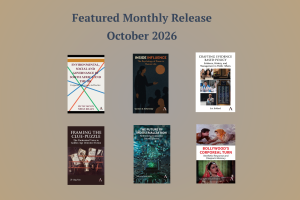
Featured Monthly Releases – October 2026
As October comes to a close, discover new titles exploring economic development, public policy, cinema, sustainability, leadership and literature. This month’s featured releases bring fresh perspectives to contemporary global challenges,...

Talk of the Town – Monthly Publishing Industry News Digest
As October draws to a close, the publishing industry continues to navigate the growing influence of artificial intelligence, evolving copyright challenges and uncertainty surrounding research funding. From developments in scholarly...

The Concept of Concepts
This is a guest post by Tony Blackshaw, author of Thirteen Ways of Looking at Leisure As concepts in the history of thought go, leisure has over the last twenty...

The Rejection of Power: Nonviolence and the Grand Inquisitor
This is a guest post by Alexei Anisin author of Nonviolence and the Grand Inquisitor Silence fills a cold dungeon cell in 15th-century Seville. Outside, the Inquisition is raging –...