



Suffering, Antitheodicy and Meliorism
This is a guest post by Sami Pihlström, author of Advanced Introduction to Antitheodicy
The affliction we see around us merely by following daily news about wars, famines, political persecution or extreme poverty – as well as the pain we sometimes experience in our own lives – may make us plunge into deep pessimism. People (and non-human animals) seem to suffer horrendously for no rational reason whatsoever, and for some sentient beings, it would presumably be better if they had never even come into existence.
Unless one believes in divine or cosmic hidden purposes, the world seems to lack any meaningful order rendering suffering functional. This pessimism is in religious traditions as well as more secular discourses countered by optimism, according to which existence is meaningful, after all. This could be so either because God designed everything, permitting evil and suffering for good reasons, or because some non-religiously interpreted overarching goal, such as the rational direction of historical progress, ultimately justifies everything.
Both the optimistic search for meaningfulness in (or despite) suffering and its counterpart, the pessimism based on the absence of any such meaningfulness, presuppose a theodicist logic analogous to religious attempts to justify God’s allowing the reality of evil. My new Anthem title, Advanced Introduction to Antitheodicy, argues not just against specific theodicies but the very justificatory project itself shared by optimists and pessimists alike.
By so doing, the book defends meliorism (Lat. melior, better) as a critical middle ground between optimism and pessimism. Neither a positive ‘happy end’ nor a total catastrophe is predetermined; the world is dangerous, precarious and sometimes horrible, but it is at the same time a place where human thought, inquiry and action may make a difference and where our inescapable task is to do whatever can be done to alleviate suffering at both individual and social levels.
Meliorism must, accordingly, take pessimism seriously: the world we live in is, indeed, a troubled place, and there is irreconcilable suffering that must not be subordinated to the optimist illusions of theodicy. However, this does not mean, pessimistically, that ethics and human values do not matter at all. On the contrary, antitheodicy is an ethical stance ultimately aiming at amelioration: we can live better by becoming antitheodicists.
Moreover, viewing the world without the pseudo-consolation of theodicies – either religious or secular – changes everything. Therefore, my introductory volume approaches antitheodicy as a transcendental issue in a Kant-inspired sense. We should not reject theodicies by moralistically condemning their advocates; we should, instead, understand them as illusory and thus in a sense impossible. Adopting antitheodicy instead of theodicy is a choice pertaining to our appreciating the necessary conditions for the possibility of an ethical stance to our lives with other human beings.
Theodicies, however, have a tendency of returning. We can presumably never completely avoid implicitly rendering others’ suffering meaningful, allegedly serving some function or purpose. But we can, melioristically, try to become better aware of this humanly natural inclination and adopt a more critical perspective on our own theodicist tendencies. Antitheodicy is never completed but must be continuously achieved.
Latest Posts

The Anthem Beckett Studies Reader: Re-viewing Beckett (2026)
This is a guest post by S.E. Gontarski, author of The Anthem Beckett Studies Reader: Re-viewing Samuel Beckett The subtitle to this volume of critical essays, Re-viewing Samuel Beckett, punctuates...
Talk of the Town: Monthly Publishing Industry News Digest
As July comes to an end, the publishing sector continues to respond to rapid technological change, shifting research priorities and renewed conversations around open access, publishing quality, academic resilience and...
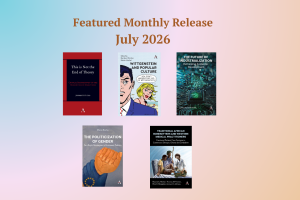
Featured Monthly Releases – July 2026
This July, explore a collection of thought-provoking new titles that address philosophy, politics, healthcare, culture and sustainable development. Our featured releases offer fresh perspectives on some of today’s most pressing...

How Gender Became a Political Weapon for the Far Right
This is a guest post by Maria Barbu, author of The Politicization of Gender In 2016, the election of Donald Trump did more than disrupt American electoral politics. It redefined...