



Cultural Diversity After the Crisis of the Rules-Based Order
This is a guest post by Federico Luis Escribal, author of South American Perspectives on Cultural Diversity: An Analysis of Contemporary Cultural Policies in Argentina, Brazil and Peru
The beginning of the second quarter of the twenty-first century seems marked by two concurrent dynamics: the growing sterility of an internationalist apparatus inherited from the second half of the twentieth century and the return of hierarchical modes of relating that have once again offered subjectivity, rootedness and social anchorage, largely in reaction against certain forms of the discourse of diversity. These two phenomena are usually considered separately. In my view, they form part of the same conjuncture.
In a few weeks, I will be presenting my forthcoming book, South American Perspectives on Cultural Diversity: An Analysis of Contemporary Cultural Policies in Argentina, Brazil and Peru. In it, I trace the historical origins of the term and its trajectory across appropriation, dispute and normativity, reading cultural diversity through the lens of power relations. Originally forged in international relations, the term moved into public cultural policy during the first decades of the century. In that transition, it broadened its initial formulation – oriented towards safeguarding national production in the cultural industries – in the context of historical political struggles led by racialised groups condemned to precarious socio-economic conditions, first through racial coding and later through cultural traits defined as ‘backward’. Yet, in that process of appropriation, the political force of the dispute was gradually restricted: debate became increasingly confined to the public presence of diverse identities and the expansion of heritage repertoires, while the possibility that other cultures might appear as bearers of political culture, ontological tradition and epistemic validity was effectively sealed off. In prevailing terms, identitarian and cultural difference came to be admitted as local colour or as the demand of identity-based segments, without being recognised as a legitimate interlocutor in the definition of the common.
At a time when the rules-based international order is visibly losing credibility, and when the social regimes through which truth is elaborated are being distorted, the discussion of cultural diversity acquires a density less ornamental than is usually attributed to it. The maintenance of unequal forms of power management within states and between them not only exposes a selective breach of the rules: it also compels philosophical reflection. What appears there is the persistence of a hierarchical mode of producing culture that reserves for some actors the monopoly of political rationality and historical decency, while pushing others, on the basis of traits presented as natural, into an anticipatory condition of condemnation sustained by epistemological negation. Certain collectives – social, identitarian, cultural – cannot, within the dominant cultural matrix, appear as bearers of a rational agenda of legitimate interests grounded in the values they have collectively and historically constructed. The problem does not lie only in the fact that certain states or groups are judged by a different standard. It lies in the fact that, even before their actions are evaluated, they are denied the condition of full interlocutors. Deprived of the possibility of being thought of as bearers of a political agenda of their own, a tradition of thought and a historical logic intelligible within the translation work demanded by the contemporary geopolitical Babel, they become ethically elusive, and that subtraction makes it possible to reserve immorality for them while tacitly presenting others as the repository of ethics and morality.
Naming this problem requires a theoretical scaffolding capable of accounting for the fabrication of the other, the peripheral internalisation of that hierarchy and its effects on subjectivity itself. Said showed this with particular clarity in Orientalism (1978): the other does not simply appear as different but as an alterity worked upon by imperial power, available to be interpreted, corrected or contained from the outside. Yet that operation does not end with external domination. Jauretche, in La colonización pedagógica (1967), allows us to see how those hierarchies become more effective when they install themselves within the cultural fabric of the peripheries, which end up reading their historical experience through categories not their own and assessing their possibilities according to criteria that subordinate them. Fanon, in Peau noire, masques blancs (1952), takes this understanding further by showing that colonial violence organises not only political orders or cultural repertoires, but psychic economies as well: inferiorisation inscribes itself in subjects, wounds their relation to themselves and makes the gaze of the dominator aspirational. What this arc allows us to understand is that the denial of one entity to the other is never purely diplomatic, nor merely ideological: it is a broader historical operation.
These mechanisms of power in the production of subjectivities decisively shape the modes through which cultural policies are elaborated in Latin America. In the book, I address precisely this issue: how state action, articulated through the normative deployment of cultural rights – purportedly universal and, at the same time, specific – came to reinforce the elitism entrenched in restrictive conceptions of culture. The horizon of cultural democracy was buried beneath the tectonic force of the Enlightenment and its theoretical and technical apparatus. Culture continued to operate, to a large extent, as a euphemism for the fine arts: for that which only the cultivated would be in a position to produce, appreciate and legitimise.
Hence, the discussion of cultural diversity cannot be exhausted in festivals, acts of recognition or gestures of symbolic inclusion, nor in technocratic discourses that accept difference only when it can be codified through the language of the state or the market. Indigenous, Afro-descendant, peasant and migrant organisations make this clear: transformation is not at stake in the visible presence of racialised people within purely Western, postmodern and stylised formats; it entails rethinking ways of life through other ways of doing politics, of world-making and of relating to oneself, others, the community, nature and the textures of time. If culture also refers to the systems of values through which a society organises what is just, dignified and liveable, then cultural diversity names a far more demanding dispute: the dispute over the criteria of intelligibility and legitimacy that organise collective life.
It is this displacement that, in the final stretch of the book, leads me to propose a pluriversal orientation for South American cultural policy: a situated universalism capable of entering into relation with heterogeneous ontologies, memories and territorialities without degrading them in advance. Twenty years after UNESCO’s 2005 Convention, the urgent question is not only how to protect diversity but also how to reorganise, from diversity itself, the conditions under which culture, politics and life may once again become mutually intelligible.
Courtsey: The cover photo credits belong to Mauricio Mascaro (https://www.instagram.com/
Latest Posts

Talk of the Town: Monthly Publishing Industry News Digest
As August comes to a close, the publishing industry continues to balance strong traditional markets with rapid technological change, as AI reshapes discovery and scholarly communication while questions of research...
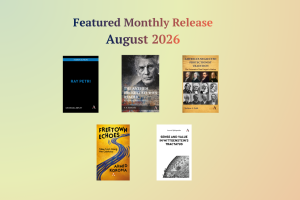
Featured Monthly Releases – August 2026
This August, explore ideas that broaden perspectives, spark new thinking and contribute to meaningful conversations. Discover our featured releases for the month. The Anthem Beckett Studies Reader – Re-viewing Samuel...

Leaping Forward, Sliding Back: The Intangible Revolution Reshaping Economic Formations
This is a guest post by Theo Reks, author of Controlled Economic Evolution At the beginning of summer, a great many things tend to happen. Before people settle into a...

The Anthem Beckett Studies Reader: Re-viewing Beckett (2026)
This is a guest post by S.E. Gontarski, author of The Anthem Beckett Studies Reader: Re-viewing Samuel Beckett The subtitle to this volume of critical essays, Re-viewing Samuel Beckett, punctuates...