



For African/African American Humanity
This is an interview with Lawrence Hogue, author of Struggle, Resistance, and Decolonization in African American Literature after 1960
- What is the aim of this book?
From the seventh and eighth centuries, as Muslim Arabs moved across North Africa, conquering Black Africa, and Europeans colonised sub-Saharan Africa, they represented the Black African subject (and cultural forms) as inferior, as savage and/or as nonhuman, with the great African kingdoms and their complex human civilisations being appropriated, suppressed, erased or defined as devalued other. This dehumanised and demeaning representation of the Black African subject was transplanted to the Americas, where Black subjects suffered under slavery and colonialism and were also denied their cultures and languages. In this book, first, I wanted to construct a pre-colonial Africa, as a way of refuting this image of Africa as primitive. Second, I wanted to show how Africans and African Americans historically through oral traditions, folktales, music and writings not only resisted this dehumanisation but also created art and literature and music that demonstrated their humanity. Third and finally, I wanted to show that despite the racism, terror, trauma and dehumanisation, Africans and particularly African American writers chose not to be bitter or vengeful but to show love and compassion.
- Why the connection between African American literature and Africa?
From the time of Phyllis Wheatley in the seventeenth century, African American writers have had a relationship or kinship with Africa, with it being a part of their heritage, their mythical consciousness or lodged in the deep recesses of their imagination. The relationship became more pronounced during the Harlem Renaissance in the 1920s and 1930s and the Black Arts movement in the 1960s. During these periods, African American writers and musicians critically revisited, reclaimed, reassessed and incorporated African cultural and spiritual forms and legends into their art and literature. Very few African American critics have seriously flushed out how the connection to Africa makes for a fuller African American subject or for a greater sense of their being. Because writers of the 1960s had a greater sense of this relationship/connection, I wanted to flush out that aspect of the literature.
- Why the 1960s?
First, we are still living in the historical and cultural aftermath of the 1960s, which has an immense effect on African Americans today. In great social and psychological and literary movements, new values, new ways of making sense of the world, new ways of defining reality and new ways of living in the world emerge. And African Americans are still living in the midst of this movement. I wanted to explore the contemporaneity of the sixties, in national and international contexts. The importance of reading these sixties’ texts against the cultural and historical past. The sixties were a time when African American writers delinked from mainstream American literature, decolonised their minds and used the denigrated and discredited diasporic African beliefs and African American folk culture to resist, to disrupt stereotypes and to expand/reconfigure the category of human to include the Black African/African American. The literature of this period shows a greater and/or fuller sense of their subjectivity.
- What is the significance of framing the Conclusion with the quote by Gramsci?
The world is constantly changing, and at any given period in history we can talk about certain things dying and other things emerging. I wanted to position African Americans and African American literature within the binary of the dying world order and a new world order struggling to be born. Since the book manuscript deals with the sixties, in the first chapter, I defined the sixties movement and the subsequent literature as part of an international liberation movement, challenging the U.S.-led world order. In the Conclusion, I wanted to reinforce the idea that this literature, since the 1960s, is also a part of a new world order struggling to be born.
- What were your critical approaches to this literature?
African Americans are in a unique position in the world. For more than four hundred years, he has existed in the West. This means, he is subjected to all of the modern maladies of the West, including alienation, fragmentation, despair, dislocation, self-hatred, patriarchy, racial oppression, trauma, terror and so on. He has to make sense of the world in the midst of these catastrophes. He also belongs to pre-colonial Africa, which means he has a need for spirituality, wholeness and community. Both of these features are present in the literature. Therefore, I use decolonial, postcolonial, trauma, feminist, psychological, existentialist and poststructuralist theories to critically explicate this literature and to demonstrate how African American writers engage these modern maladies and get the African American to a position of wholeness and well-being and community.
Latest Posts

Talk of the Town: Monthly Publishing Industry News Digest
As September draws to a close, the publishing industry continues to explore new connections between books, technology and audiences. From AI’s growing influence on academic writing and peer review to...
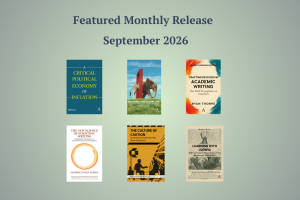
Featured Monthly Releases – September 2026
As September closes, discover new titles that explore writing, media, music, life and economics from fresh interdisciplinary perspectives. Our featured releases offer thought-provoking approaches to academic communication, cultural experience and...
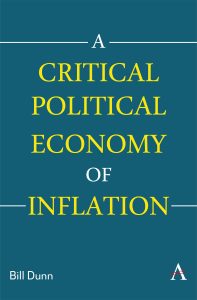
Towards a Critical Political Economy of Inflation
This is a guest post by Bill Dunn, author of Critical Political Economy of Inflation Inflation is back in the news. And it deserves attention. It is economically but also...

Talk of the Town: Monthly Publishing Industry News Digest
As August comes to a close, the publishing industry continues to balance strong traditional markets with rapid technological change, as AI reshapes discovery and scholarly communication while questions of research...