



The Second Cold War and beyond
This is a guest post by Richard Sakwa, author of The Culture of the Second Cold War
Three decades ago, we believed that the era of the Cold War had come to an end. How wrong we were. The style of politics associated with the Cold War lives on. In the end, this gave rise to Cold War II, in which we are now deeply and dangerously embroiled.
The idea of cold war does not cover everything important in international politics today, but it does identify an important element – the cultural patterns associated with a style of politics in which the adversary is not just another power, great or small, antagonistic to the interests of the other, but is condemned as a manifestation of evil. Thus, conflict is rooted less in contesting policy options than in the character of the opponent.
This has generated a distinctive cold war style of international politics. This includes entrenched militarism, the suppression of dissent, the decline of diplomacy, reduced opportunities for dialogue and the narrowing of policy choices. The instruments of Cold War II include sanctions, disinformation campaigns, intensified information management and memory wars.
This is a distinct style of politics associated with the epochal contest between capitalism and communism in the twentieth century, which then became formalised after World War II in the contest between the United States and the Soviet Union. The superpower dimension of the contest came to an end in 1989, when the Soviet Union under the leadership of Mikhail Gorbachev sought to transcend the logic of conflict. The Soviet Union itself disintegrated two years later, leaving the United States as the last great power left standing.
Instead of the transformation of international politics, the U.S.-dominated Political West in the post–Cold War era focused on the expansion of its system. That opportunity for a reset of international politics was lost, and with it, the prospect for elements of a positive peace focused on development. There was little prospect of global problems and intractable conflicts, of the type that beset West Asia, disappearing, but for a brief moment, the international context was open to change. This is not naïve or unrealistic idealist thinking, but a necessity driven by the complex challenges facing humanity, ranging from the increased threat of nuclear war, pandemics and above all, climate change.
Instead, the U.S.-led Political West in the post–Cold War era radicalised and claimed the prerogatives and privileges that properly belong to the United Nations–based Charter International System. The liberal international order that the United States sponsored after 1945, with its economic institutions based on the Bretton Woods institutions and the security structures associated with liberal hegemony, claimed to be universal. There can be no legitimate alternative, and the whole world will sooner or later become part of this system. The U.S. hegemony is presented not only as the katechon, holding back the tide of global anarchy, but also as the manifest destiny of humanity.
The free trade regime, liberalisation of the international financial system from the 1970s, removal of restrictions on capital flows and much more was termed ‘globalisation’ and provided the framework for an unparalleled era of prosperity and global peace (although there were numerous regional wars). This was accompanied by universalism, the view that democracy, human rights and liberal freedoms were universal public goods and should be applied everywhere and at the same time. Hegemonic practices gave rise to democratic internationalism, in which proclaimed ethical norms trumped national autonomy and sovereignty. This undermined the sovereign internationalism at the heart of the Charter system.
The earlier cold war conflict between communism and capitalism has given way to a more amorphous but, paradoxically, more intense struggle between representations of the political good. These are the issues discussed in my book, The Culture of the Second Cold War (Anthem Press, 2025). The book examines the metapolitics – the deeper structures – of the Second Cold War. It tries to make sense of Cold War II and thereby indicates a path beyond its associated cultures.
Latest Posts

Talk of the Town: Monthly Publishing Industry News Digest
As September draws to a close, the publishing industry continues to explore new connections between books, technology and audiences. From AI’s growing influence on academic writing and peer review to...
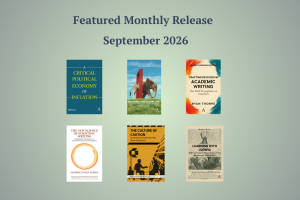
Featured Monthly Releases – September 2026
As September closes, discover new titles that explore writing, media, music, life and economics from fresh interdisciplinary perspectives. Our featured releases offer thought-provoking approaches to academic communication, cultural experience and...
Towards a Critical Political Economy of Inflation
This is a guest post by Bill Dunn, author of Critical Political Economy of Inflation Inflation is back in the news. And it deserves attention. It is economically but also...
Talk of the Town: Monthly Publishing Industry News Digest
As August comes to a close, the publishing industry continues to balance strong traditional markets with rapid technological change, as AI reshapes discovery and scholarly communication while questions of research...