



Meet the Series Advisor: Tomasz Ewertowski
Anthem Studies in Encounters between Peripheral Regions publishes studies on encounters and interactions between peripheral regions of the world system. The editor of the series is Tomasz Ewertowski from Shanghai International Studies University, China. He graduated from Adam Mickiewicz University in Poznań, Poland, and moved to China in 2013. He has served as the principal investigator for two grants from the Polish National Science Centre and his publications include the monograph Images of China in Polish and Serbian Travel Writings (Brill, 2020) and the edited collection Transport Revolution and Travels to Asia, 1860s–1920s (Routledge, 2025).
- What inspired the creation of this series and what motivated you to take on the role of series editor?
The idea behind the series was inspired not only by what I perceived as a gap in scholarship, but also by my personal experience. As someone from East-Central Europe who has lived for many years in China and is married to a Chinese person, I am myself a participant in and a product of encounters between different civilizations. Moving from the personal to the professional, my research for many years has focused on Polish, Serbian and, more generally, Central and Eastern European travels to East Asia. Through my readings, I acquired a feeling that the global story of the last few centuries too often is told in a simplified way, in ‘the West and the rest’ mode, suggesting that large areas of the world were merely passive receivers of transformations originating in the so-called ‘core region’. Whereas one could hardly describe China nowadays or China of the Tang dynasty as a ‘peripheral region’, in stereotypical formulations the core region of the world is still identified with the so-called West, which through industrialization and colonialism cast a deep shadow on the rest of the world. Of course, there is a great deal of excellent scholarship which shows other dimensions of past and present global interactions; however, such studies are often scattered in various places and therefore do not form a coherent narration which could influence the general public. Therefore, the idea of the series is to collect in one place voices demonstrating how various ‘non-core’ areas of the world met in the past
- What key themes or questions does the series aim to explore, and why do you think they matter in today’s academic or cultural landscape?
Entanglements between different civilisations can be better understood by analysing the activities of actors who did not originate from the core of the world system or its colonies but rather from areas that were seemingly a backwater. Historical archives reveal a number of surprising facts which demonstrate the interconnectedness of the world, such as the fact that the first Indian participant in the Winter Olympic Games was a Lithuanian-born child of a Polish couple who moved to India after the Second World War, or that the first Japanese diplomatic mission to Mexico arrived there already in the early seventeenth century, or that the first person born in China who wrote about Europe was a Uyghur Nestorian monk in the service of the Mongol rulers of Persia. We can treat such cases merely as curiosities, but it is much more fruitful to undertake a comprehensive study and try to build a general picture on this basis. This is particularly important in the current world of global changes.
- How do you identify and shape the titles that become part of the series? What makes a proposal stand out to you?
The series seeks to attract proposals that combine conceptual ambition, methodological self-awareness and empirical depth. A strong proposal should not only tell an interesting story about encounters but also investigate it in a systematic way, informed by current theoretical and methodological approaches.
- How do you see the series contributing to scholarship or public debate, and what kinds of conversations do you hope it will spark?
I hope the volumes published in the series will spark not only academic debates on the nature of historical processes and cross-cultural interactions but also contribute to mutual understanding between people from different parts of the globe. It is a truism that we live in a world that is increasingly connected, but events of recent years have brought considerable scepticism as to whether being ‘better connected’ means that we understand each other better. Although this aspiration may appear idealistic, by investigating past interactions between people from different regions the series ultimately aims to contribute, however modestly, to fostering a world in which cross-cultural encounters are free from violence.
- Are there any forthcoming titles or directions for the series that particularly excite you, or that reflect where you see the field heading next?
The first volume to be published in the series is tentatively entitled Encounters on the Periphery: Chinese and Eastern European Interactions, 1750–1950. It is an innovative investigation of accounts concerning encounters between Chinese and Eastern Europeans, focusing on interactions outside major centres.
Latest Posts
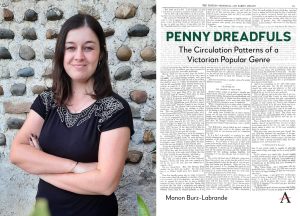
Stories in Motion: How the Victorian Penny Dreadful Circulated Across Genres, Classes and Centuries
This is an author interview with Manon Burz-Labrande, author of Penny Dreadfuls: The Circulation Patterns of a Victorian Popular Genre Can you explain what penny dreadfuls are, for readers who...

Beyond Sacred and Profane: Design, the Absolute Other and the Study of Religion
This is a guest post by Krzysztof Nawratek, Series Editor of Anthem Studies in Religion, Space and Design When people hear ‘religion and architecture’, they usually think of churches, temples,...

Meet the Author: Sophie Kazan Makhlouf
Sophie Kazan Makhlouf (PhD) is an art and architectural historian. She is an Honorary Fellow of the University of Leicester and an associate adjunct professor, teaching art history at the...
Feminism, ‘Hum Gunahgar auraten’ [We Sinful Women] and the Act of Writing Resistance: Urdu Poetry’s Rebellious Voices
This is a guest post by Amina Yaqin, author of Gender, Sexuality and Feminism in Pakistani Urdu Writing The award-winning British Pakistani film, Rahm ([Mercy] (2016), an Urdu adaptation of...