



Beyond Sacred and Profane: Design, the Absolute Other and the Study of Religion
This is a guest post by Krzysztof Nawratek, Series Editor of Anthem Studies in Religion, Space and Design
When people hear ‘religion and architecture’, they usually think of churches, temples, mosques, perhaps a shrine hidden somewhere in the forest if they are feeling slightly adventurous. In other words: buildings. Objects. It is not wrong, but it is limiting. A sacred space that works does not really ask to be looked at as anything material. If it works, you stop analysing and simply stand there — in awe or fear, absorbed, unsettled, perhaps moved, perhaps slightly disarmed. You feel first, and only later — if ever — begin to rationalise.
I was trained as an architect, and years ago I designed a few chapels and a church, so I am not hostile to architectural engagement with sacred space — space that is designed to transfix believers (and others) spiritually and emotionally, to open a gateway to another realm. And here is the paradox: religion is present in buildings and places, in rituals and through the senses, but all of these work like a gateway. The function of the material and spatial religious instrumentarium is to abandon all of these and go further, beyond time, space and matter.
For many architects, Mircea Eliade still remains the familiar reference point — his distinction between sacred and profane space, between meaning and chaos, is powerful and easy to translate into design. In religious studies, meanwhile, the discussion has become much subtler and more grounded. The spatial turn, and the work of scholars such as Kim Knott, Lily Kong and Veronica della Dora in particular, has done a great deal to move the conversation beyond binary distinctions, beyond awe and monumentality, towards mundane places that occasionally become sacred, towards everyday practice and the contested production of religious worlds. That shift matters. It opened the door to a much richer understanding of how religion happens in space and in the world. However, in the process, one aspect of Eliade’s perspective seems to have disappeared — the sense-making power of religion.
My own thinking begins there. The sense-making goes beyond explanation, beyond finding the right words to rationalise. This is why Rudolf Otto still matters to me. Otto’s The Idea of the Holy pushed me towards a basic question: what about everything that exists on the edge of language — the void between human existence and what Otto called the Absolute Other?
In a 2021 article in Planning Theory, I argued that this encounter with the unknown needs to be taken seriously in thinking about cities and spaces. Religion, I suggested, should not be reduced to its social and cultural manifestations but understood more broadly, as an ontological position defining the limitations of the human ability to fully understand and engage with the world. More recently, I coined the term sapiential spaces — spaces where belief, practice, memory, knowledge and embodied forms of sense-making come together and actively shape urban life. These are not simply sacred spaces under a new name but spaces where particular epistemic worlds are made, tested and sustained.
Once one begins from there, methodological consequences follow. If the question is not only what religion means or how it occupies space, but what religions and beliefs actually do to people — and through people to spaces — then we need tools and methods adequate to that question. This is why architectural and design-related methods become not merely useful but necessary. Not to design buildings or spaces, but to understand, through design and radical contextualisation, the tension between the linguistic and rationalising procedures we normally rely on and everything else that exceeds them.
Speculative design matters here not because it produces attractive images of possible futures, but because it allows us to test arrangements of life — to speculate about what kinds of space people’s beliefs, anxieties and hopes might require or transform. In that sense, design becomes an integral part of any epistemic toolkit.
This, I think, is where the discussion can be pushed a little further. Discourse analysis, ethnography, institutional history, political economy: all are indispensable. But they remain heavily language-dependent. If Otto is even partly right that religious experience involves an encounter not fully reducible to propositions, then methods tied primarily to text and speech will always leave an epistemic deficit. Design-related methods, by contrast, allow us to think through spatial tension, materiality, atmosphere and the uneasy coexistence of transcendence and infrastructure.
I have come to this position through work in rather different contexts. In British cities such as Sheffield, religion appears in layers: Anglican parishes, Baptist churches, Methodist chapels, mosques, gurdwaras — the list goes on. Each tradition claims its spatial presence differently; each organises its pastoral activities through different spatial, institutional and material mechanisms. In Brazil, especially in work developed with collaborators around Belo Horizonte, Pentecostal and Neo-Pentecostal spaces often emerge more quickly and more explicitly, with a clear spatial and theological logic. Different settings, obviously, but they reveal the same larger point: religion remains one of the forces through which urban life is made, negotiated and transformed.
This is the intellectual space I hope Anthem Studies in Religion, Space and Design will help to open. I do hope there will be a home here for books that take seriously the entanglement of faith, space, design, urbanism and world-making — books willing to cross disciplinary boundaries because the phenomena themselves have already crossed them.
The series is new, so this text is an invitation. Openings are usually a bit uncertain, slightly awkward and therefore alive. If your work sits somewhere between architecture, theology, anthropology, religious studies, design research and urban theory; if it takes religions seriously without trying to domesticate it; if it understands design as inquiry and speculation — then your work belongs here.
Krzysztof Nawratek is a Senior Lecturer in Humanities and Architecture at the University of Sheffield, working at the intersection of architecture, urban theory and religious studies. He has contributed to the Routledge Handbook of Postsecularity and the Bloomsbury Handbook on Religion, Space and Place, and is co-author of Epistemic Ambivalence: Pentecostalism and Candomblé in a Brazilian City (2023). His book Sacred Ruptures is forthcoming with Rutgers University Press. He is Series Editor of Anthem Studies in Religion, Space and Design at Anthem Press.
Latest Posts

Meet the Author: Sophie Kazan Makhlouf
Sophie Kazan Makhlouf (PhD) is an art and architectural historian. She is an Honorary Fellow of the University of Leicester and an associate adjunct professor, teaching art history at the...
Feminism, ‘Hum Gunahgar auraten’ [We Sinful Women] and the Act of Writing Resistance: Urdu Poetry’s Rebellious Voices
This is a guest post by Amina Yaqin, author of Gender, Sexuality and Feminism in Pakistani Urdu Writing The award-winning British Pakistani film, Rahm ([Mercy] (2016), an Urdu adaptation of...

Artificial Intelligence and Music: From Resistance to Exploitation
This is a guest post by David Arditi, author of Music Technology Panic Narratives Beyond Piracy: From Taping to Napster to TikTok The recording industry regularly paints its consumers as...
Featured Monthly Releases – February 2026
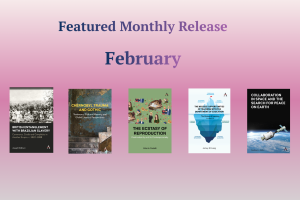
This February, embrace ideas that challenge perspectives and inspire meaningful dialogue. Take a look at our featured releases for this month. The Ecstasy of Reproduction: Postmodernity and Its Contemporaneity This...